We use cookies to improve your experience on our site and to show you relevant advertising. By clicking "Accept All", you consent to the use of ALL cookies. You can also manage your preferences or learn more about our privacy practices.
When your work shifts, it can feel like you might disappear with it.
by Drew Robbins
5 min read
Choose What Matters
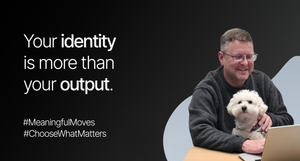
AI doesn't replace identity—it exposes where identity was too narrowly defined. Your worth isn't in deliverables; it's in how you think, respond, and contribute.
You've adapted before. A manager's expectations, a team's culture, an early success quietly taught you how to present yourself at work. Over time, adjusting what you do to fit what's needed becomes automatic. You learn when to speak, when to hold back, when to soften an idea, and when to emphasize results. Eventually, parts of your identity start to feel inseparable from the work you produce.
That is why AI lands so personally. When you hear, "It's writing my code," or, "It can do parts of my job better than I can," what's beneath it is not fear of technology. It's fear of becoming less visible, less valuable, less yourself. If your worth has been measured by deliverables and speed, a machine handling pieces of that work can feel like something intimate is being taken away.
I felt this recently in a conversation with Juan F S Burckhardt whom I deeply respect. He spoke about AI writing his code (he is a software engineer) as if it were erasing his professional identity. And yet, as he talked, I realized something quietly powerful: I had never seen his code. What I knew of him was his generosity with time, his curiosity, his way of making others feel capable, his commitment to growth. His identity, at least as I experienced it, had never been contained in what he produced.
When roles shift quickly, research shows people experience identity threat, the sense that your story about who you are no longer fits the environment around you. It's natural then to cling tightly to tasks and outputs because they feel concrete and defensible. But identity has never lived there. It lives in how you think, how you respond under pressure, how you treat people when no one is watching, and how you decide what matters. As Satya Nadella reminds us in a December Fortune magazine article, "If you just have IQ without EQ, it's just a waste of IQ," a signal that empathy and emotional intelligence become essential as automation rises.
This reframes the conversation. AI does not replace identity. It exposes where identity was too narrowly defined. If your sense of self rests entirely on performing a specific task, any tool will feel like a threat. If your identity is rooted in values, relationships, and judgment, tools become extensions rather than competitors. You can see this in later‑career shifts all the time. Teachers become entrepreneurs. Engineers become leaders. Artists become advocates. What carries across is not the task, but the way they think, care, and contribute. Identity travels.
Identity is not a possession you defend. It is a practice you cultivate. It shows up when you decide how thoughtfully to engage a problem, whether you listen or dominate, whether you frame an idea with clarity and respect, whether you mentor without needing credit, whether you take responsibility instead of hiding behind a process. It also shows up in uncertainty. When a tool produces something quickly and you pause to ask, "Is this right for this situation?" When you resist outsourcing thinking and stay engaged. When you remain accountable for outcomes, not just inputs. Those small choices accumulate. Over time, they form a durable sense of self that does not depend on any single capability. That is how you Choose What Matters in an AI era.
I am not what happened to me, I am what I choose to become.
— Carl Jung
What one capacity do you bring to your team that no system can automate, and how will you exercise it on purpose this week?
Try This
Write one sentence that names the non-automatable value you bring, such as discernment under pressure or the way you lift others, and put it at the top of your notes for the week.
Notice What Happens
Watch your decisions and conversations shift as you center that capacity instead of chasing tasks for visibility.
Share or Reflect
Comment with the sentence you wrote and one moment this week when you put it into practice.
Keep Going
Each Friday, note two choices where you honored that value and one adjustment you'll make next week to Choose What Matters.
If this resonates, share with your network to help someone else anchor identity in what lasts.