We use cookies to improve your experience on our site and to show you relevant advertising. By clicking "Accept All", you consent to the use of ALL cookies. You can also manage your preferences or learn more about our privacy practices.
You can get more done with AI and still end the day feeling like your mind never caught up.
by Drew Robbins
6 min read
Choose What Matters
AI can make knowledge work faster, but speed without consolidation can leave you mentally fragmented, physically tense, and strangely exhausted.
Someone on my team pointed me to Siddhant Khare’s article "AI Fatigue Is Real" recently when we were talking honestly about how we were doing. The piece gave language to something that is easy to miss when your output looks fine from the outside. You move through the day faster than you used to, but your mind does not always come with you.
You answer messages, clean up a draft, summarize a document, outline a presentation, and open three more possible directions before lunch. None of that is fake work. It is useful work. But by the end of the day, you are not exactly behind and you are not exactly settled either.
That in-between feeling matters. Your shoulders are tight. Your attention feels scattered. You are oddly tired for someone who technically got a lot done. If the output is there, why do you still feel frayed?
Khare names the problem clearly. AI makes it easier to start, switch, expand, and reopen work all day long. The issue is not always effort alone. Sometimes it is fragmentation. You are carrying too many half-open loops at once, and your nervous system is still trying to catch up.
That is what makes this kind of fatigue so confusing. AI genuinely helps. It clears admin, speeds up drafts, and gives you traction when you are stuck. But when every task gets easier to begin, more work stays active in your head. A quick prompt becomes three new options. One solved problem creates five more things you could do next.
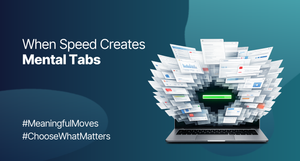
After a while, the day stops feeling like a sequence and starts feeling like a stack. You have touched a lot, but you have not really landed anywhere. That is why the exhaustion can feel thin, restless, and hard to explain. It is not always burnout in the dramatic sense. Sometimes it is just your mind being asked to live in too many places at once.
That is why this is worth noticing early. If you keep treating fragmentation like a personal weakness, you will keep blaming yourself for a work pattern that would strain almost anyone. The better question is not whether AI is helping. It probably is. The better question is whether the way you are using it is helping you close loops or just multiply them.
What people often need is a better standard for what productive work should feel like. Not just fast. Not just full. Coherent.
The software scales faster than the nervous system.
— Siddhant Khare, AI Fatigue Is Real
What changes if you stop judging a productive day by how many threads you touched, and start judging it by whether your mind still feels whole when the day is done?
Try This
Pick one part of your day where AI can help you finish something, then protect the time it gives back instead of filling it. Step away, read for a few minutes, or check in with a colleague.
Notice What Happens
Pay attention to whether you feel calmer after using AI to close a loop instead of opening more possibilities.
Share or Reflect
Ask yourself where your fatigue is really coming from right now: hard work, or too many mentally active tabs.
Keep Going
End each day by naming and closing three open loops so speed does not quietly turn into sprawl.
If this resonates, share with your network to help others build ways of working that are useful without leaving them mentally scattered.